


Nestled among the gentle hills, green meadows and distinctive landscapes of Upper Swabia lies one of the world’s most important centers for tower crane technology: Liebherr-Werk Biberach GmbH. Since its founding in 1954, the company has been developing and manufacturing high-performance tower cranes and mobile construction cranes for construction sites around the globe.
Whether for residential housing, industrial facilities or skyscrapers, cranes from Biberach provide the lifting solutions that help turn ambitious visions into reality. With one of the industry’s most comprehensive product portfolios, Liebherr-Werk Biberach GmbH is now recognized as one of the world’s leading manufacturers of tower cranes.
The dynamic nature of the site is clearly visible. Increasing demands for product variants, digital control systems and increasingly sophisticated crane technologies require modern manufacturing and quality assurance processes. At the same time, it became apparent that traditional testing procedures and legacy test benches could no longer fully meet the requirements of an increasingly connected production environment. Together with IGH Automation, Liebherr therefore developed a new automated testing architecture that has since become a strategic component of its quality management system.
From Software-Based Test Benches to a Modular Testing Strategy
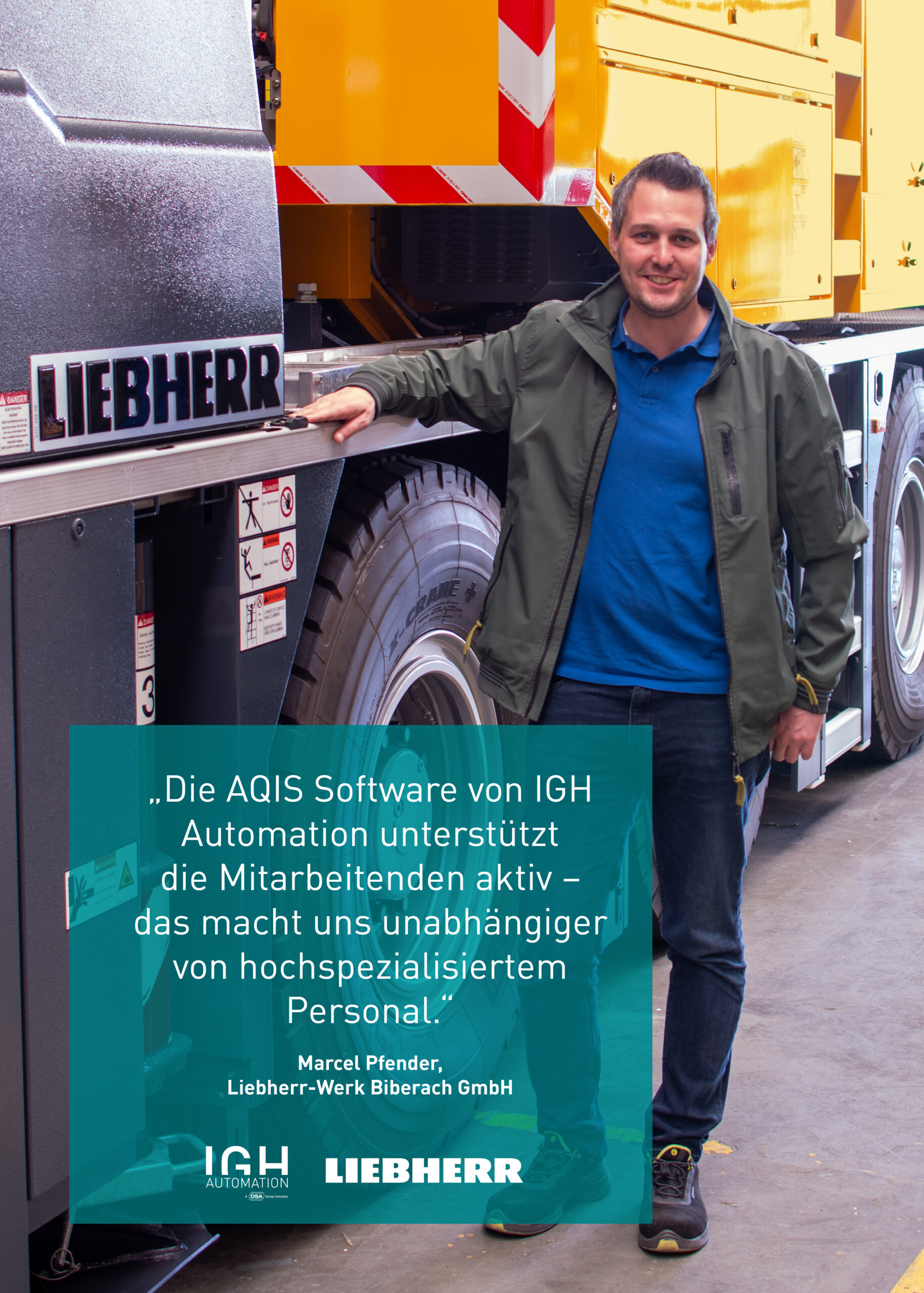
“A test bench is not a rigid system. Products change, regulations change. That’s why we need maximum flexibility,” explains Marcel Pfender, Manufacturing Engineer at Liebherr and responsible for the strategic development of testing systems.
What may initially sound like a technical detail has a significant impact on day-to-day production. In the past, large assemblies were often tested only at a very late stage of the manufacturing process. When errors occurred, extensive troubleshooting was required, testing areas became blocked, and downtime increased substantially.
As a result, testing activities were systematically moved further upstream in the production process.
Today, Liebherr tests many assemblies during the assembly phase itself and within the production cycle, long before the complete crane system is finalized. Individual components are tested independently and then integrated into the subsequent production process as verified units. This increases process reliability, improves production workflows and provides greater transparency throughout the entire manufacturing process.
“We test assemblies earlier and more independently. This saves time, space and costs,” summarizes Pfender.
Digitalization Replaces Error-Prone Paper-Based Processes
The introduction of the new testing strategy also marked a major step forward in digitalization. Where handwritten test reports and manual serial number recording once dominated the process, the software-based testing platform from IGH Automation now manages the entire workflow.
The inspection of a crane cab now begins with a serial number scan and subsequently proceeds largely automatically. Multiple functions are tested simultaneously, input values are validated, test results are documented digitally, and all relevant information is automatically transferred to higher-level systems. Every piece of testing data, from measurement values and software versions to exact test timestamps, is fully traceable.
In a manufacturing environment increasingly characterized by growing product diversity, more complex products and a shortage of skilled workers, digitalization provides essential prerequisites for both quality and efficiency.
This is particularly relevant at Liebherr. Modern crane cabs are no longer simply operator workstations. They have become integral components of advanced crane systems, combining extensive sensor technology, digital control systems, safety functions and intelligent interfaces. Consequently, the requirements for reliable, standardized and adaptable quality assurance continue to increase.
Knowledge Stored in the System, Not Just in People’s Heads
The digital testing platform also helps address the growing shortage of skilled labor. The software guides employees step by step through the testing process and contributes to preserving and making technical expertise accessible. While expert knowledge remains indispensable, it can now be integrated more efficiently into daily operations and leveraged for the continuous improvement of testing processes.
“The software actively supports employees and makes important know-how more accessible, particularly for colleagues with less professional experience,” explains Pfender.
Various modules of IGH Automation’s AQIs software platform, integrated directly into the testing systems, are used for this purpose. One of the platform’s key advantages is its adaptability to new requirements. Changes to products, processes or regulatory requirements can be implemented quickly without fundamentally altering existing system structures.
This also means that Liebherr is already well prepared for future regulatory requirements, including the upcoming Machinery Regulation.
Measurable Improvements in Daily Production Operations
The effects of the new testing architecture are clearly visible in everyday production. Errors are detected much earlier, significantly reducing rework and downtime. Testing stations are blocked less frequently because assemblies are validated before complete system integration. At the same time, the digital capture and evaluation of testing data ensure substantially greater process stability and full traceability of all relevant information.
In the past, individual errors could consume several days of production time and trigger extensive investigation and analysis efforts. Today, these deviations are identified during early production stages before they impact downstream processes. As a result, not only is troubleshooting accelerated, but overall production lead times are reduced as well.
A Partnership Rather Than a Traditional Supplier Relationship
The collaboration between Liebherr and IGH Automation evolved gradually over several development phases. Today, numerous systems are successfully operating in live production environments.
“Our relationship is truly collaborative. We jointly develop ideas for the continuous improvement of our quality processes because standardization and flexibility must coexist in modern manufacturing environments without creating isolated solutions. What I particularly appreciate is that I can always reach my dedicated contact person, and we can rely on commitments being fulfilled,” says Pfender.
Software-Based Test Systems as a Strategic Success Factor
What Liebherr has achieved extends far beyond the modernization of individual testing stations. Digital testing systems are increasingly becoming a core building block of modern production architectures: scalable, data-driven and highly adaptable.
In other words, the production halls in Biberach are not only where cranes for construction sites around the world are built. They are also where manufacturing and quality processes are created that are already designed to meet the challenges of tomorrow.
Would you like to find out more?
Would you like to know how digitalisation and automation can be implemented in your business?
Contact our experts for a no-obligation consultation.
